



Coffee houses are just as much a part of Budapest’s history as the Danube, the ring roads or the turn-of-the-century palaces. However, the old Budapest coffee houses meant far more than just a cup of coffee. They were meeting places, workplaces, and social and cultural spaces where people read newspapers, struck business deals, debated, wrote or simply watched the city go by.
The coffee house has therefore become more than just one genre of Budapest’s hospitality scene. A distinctive way of life has developed around it, one which has shaped everyday life in the capital for a long time. Part of this story is the MUZEUM Café It too: its predecessor opened its doors in 1876 next to the Hungarian National Museum, at a time when Budapest – and with it, café life – was flourishing.

Source: FSZEK Budapest Collection
When Budapest became the city of coffee houses
The history of coffee houses in Budapest began well before the 19th century, but their true heyday is linked to the rapidly developing metropolis. Budapest was born out of the 1873 merger of Pest, Buda and Óbuda, whilst new roads, public buildings and apartment blocks reshaped the city.
A changing Budapest also needed places where people could meet. Budapest’s cafés were particularly well-suited to this purpose. In the city centre, along the boulevards and at key junctions, cafés of various character sprang up one after another, each eventually developing its own clientele and regulars.
There were places frequented by writers and journalists, whilst elsewhere artists, traders, politicians or university students would meet. A café could thus be not only a place to eat and drink in the neighbourhood, but also an important hub of city life.
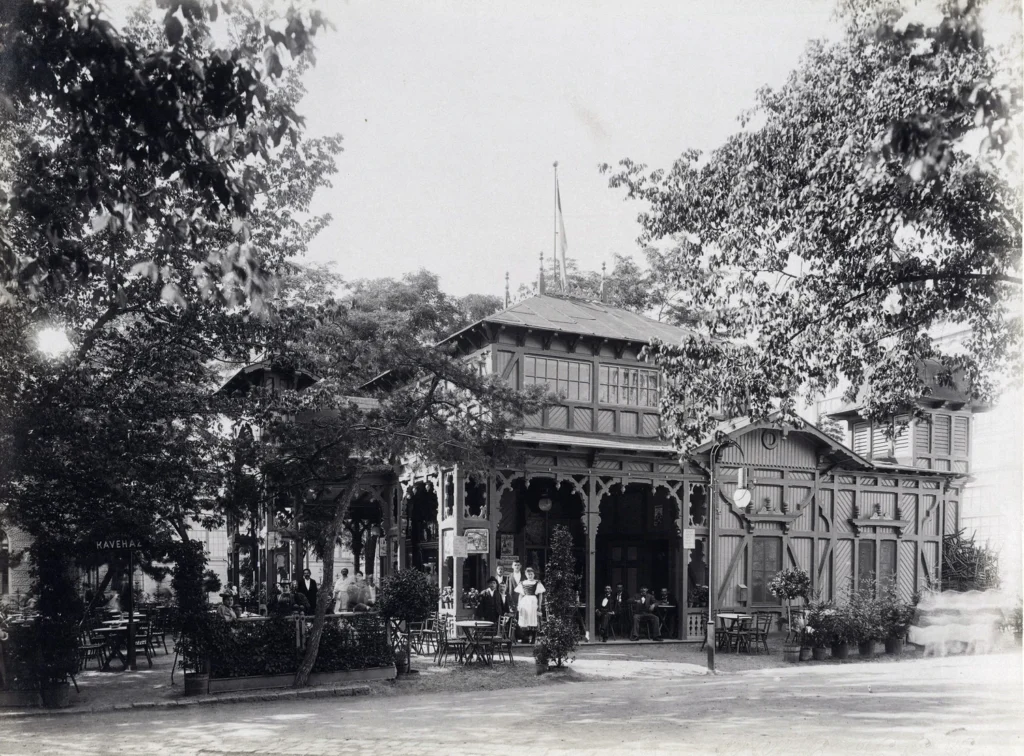
Fortepan / Budapest Metropolitan Archives. Archive reference number: HU.BFL.XV.19.d.1.09.079 / György Klösz /
More than just coffee – a unique coffee house culture
One of the most interesting features of coffee-house culture was precisely that guests did not necessarily come simply to have a quick bite to eat and move on. You could spend time in the coffee-house.
You could read the papers, chat, work, hold meetings or meet up with others. For writers and journalists, some cafés became almost a second workplace. Regulars’ groups formed, whose members met at the same place on a regular basis, and news, thoughts and stories were exchanged whilst sitting at their usual tables.
And, of course, there was food on offer too. Alongside coffee, the menu included breakfasts, pastries and a variety of dishes, meaning that the café could fulfil different roles at different times of the day. The history of coffee houses is therefore about much more than just the history of hospitality. Budapest’s social, cultural and intellectual life also unfolded around the tables of these coffee houses.
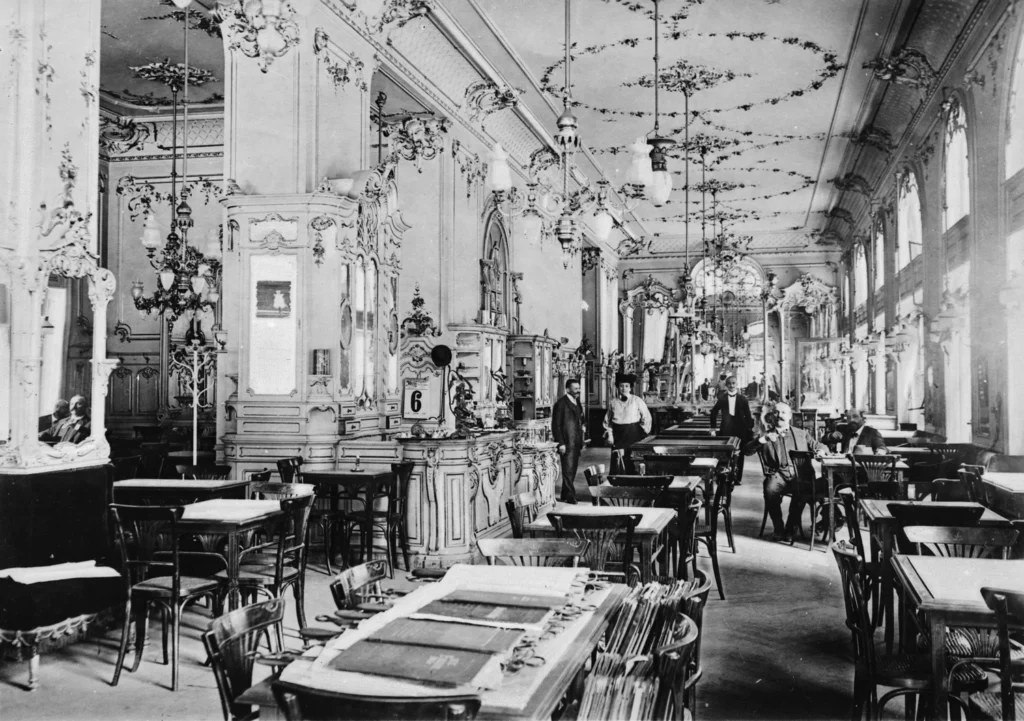
Fortepan / Deutsche Fotothek / Brück und Sohn
Writers, artists and regulars’ tables
When people think of the old Budapest cafés today, literature is often the first thing that springs to mind. This is no coincidence. Many cafés were associated with writers, poets, editorial offices and artistic circles. Coffee-house life, however, was not exclusively the preserve of famous people.
It was precisely this that made it special: the fact that it could be part of everyday city life. Regulars, groups of friends, students and people from all walks of life shared these spaces. Some came to work, others to chat or catch up on the news, whilst others simply came to enjoy the company of others. Perhaps that is why so many stories about the old cafés have survived. They did not merely provide a backdrop to city life: they became part of it themselves.
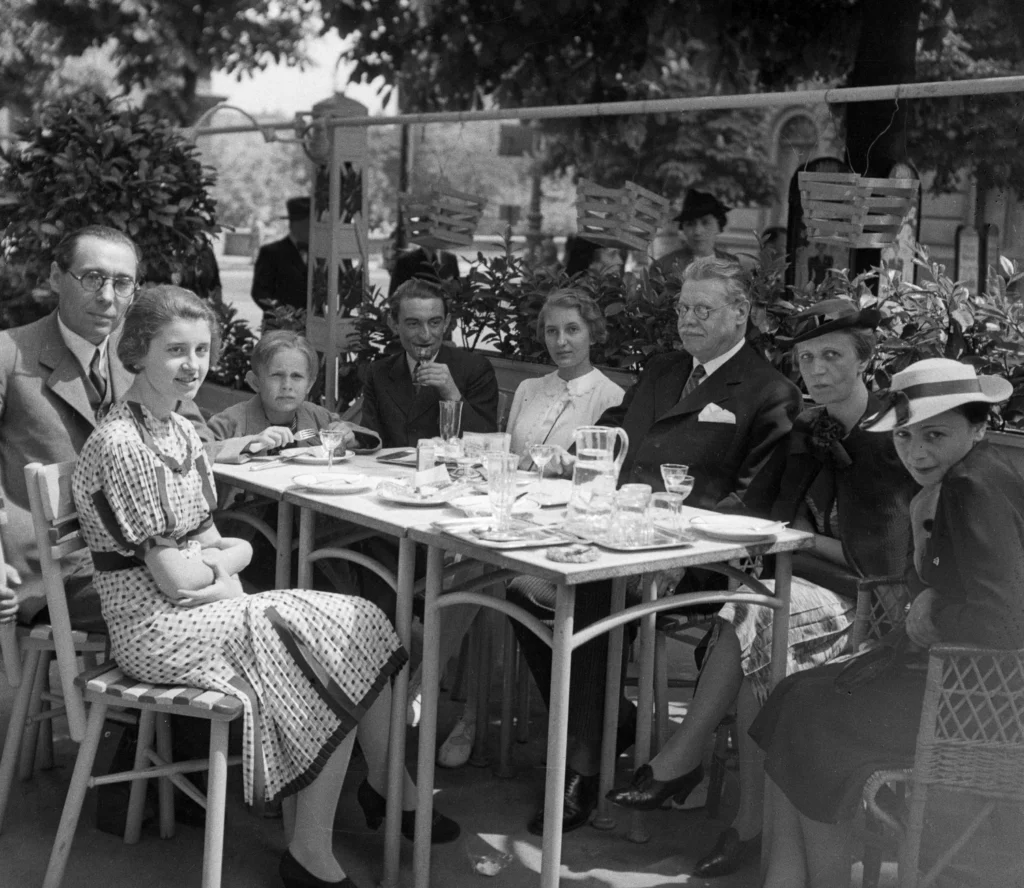
Fortepan / Bálint Magyar
1876 – a new café next to the National Museum
It was in this vibrant world that today’s story began The history of MUZEUM On 22 June 1876, Ádám Schodl’s café opened its doors on the corner of what is now Múzeum körút and Bródy Sándor utca. The location was particularly fortunate: the Hungarian National Museum, the university and the House of Representatives of the time were all nearby. The neighbourhood played an important role in the cultural, scientific and political life of the second half of the 19th century.
The café soon found its own clientele. Its guests included historians, members of parliament and politicians, whilst university students also visited it regularly. Later, scholars, writers and editors became part of the venue’s history, and various regulars’ groups formed within its walls.
From 1885 onwards, it operated under the name ‘Múzeum Kávéház’. Owners, tenants and patrons came and went, whilst Budapest was constantly changing around it. Yet the café’s history continued in the very same location, right next to the Hungarian National Museum.
Thus, the history of MUZEUM is not a separate chapter in the city’s past, but rather part of the wider story that Budapest’s old cafés tell about the city.
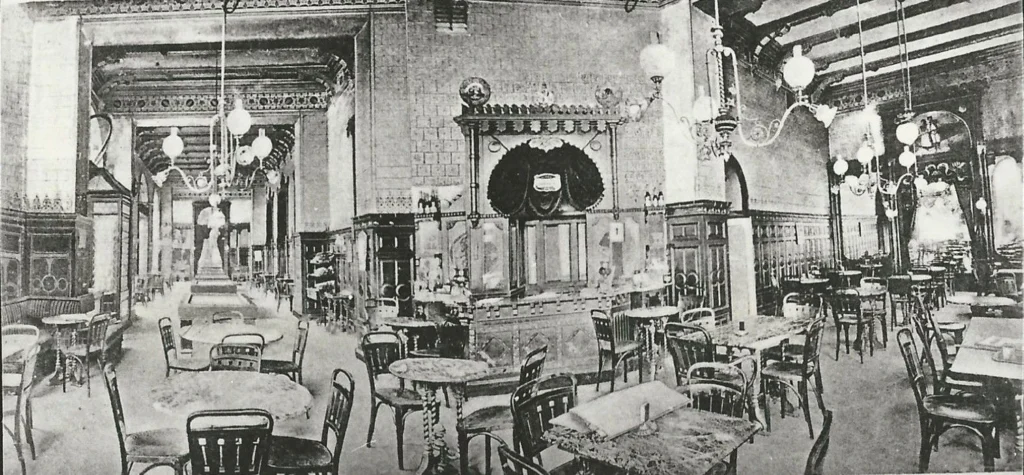
Source: Hungarian Museum of Trade and Hospitality, Budapest, item no. VF_36_233.
Then and Now – what remains of the golden age?
Today’s Budapest is, of course, not the same city as the one in which Schodl’s café first opened its doors in 1876. We work differently, we find our way around differently, and our social lives have also changed a great deal.
Yet something has remained familiar. Even today, we still pop into a café to meet someone. To have time to chat. To step away from the rhythm of the city for a while, for the sake of breakfast, a coffee, lunch or a long afternoon. Even today, the café can be a meeting place, a cultural space and a venue for shared experiences. For MUZEUM, therefore, the past is not merely a backdrop. The value of this story, which began in 1876, lies precisely in the fact that there is something to carry forward from it.
‘Anno and Now’ is about this connection: how the heritage of a historic Budapest café can meet today’s gastronomy, culture and hospitality. For perhaps the most important legacy of the golden age of the coffee houses is not an object, an old photograph or a historical date. Rather, it is what happens around the tables. And it continues with every new encounter.

Continue the story at the MUZEUM Café!
The legacy of that golden age lives on today around the dinner table, in the flavours and in new encounters.